Monday, 16 May 2011

SAVING THE WORLD, ONE BOOK AT A TIME

Hello and happy Monday, dear readers. Today, I need to address an excellent question which was put to me by faithful commentor Alex, who said:
I've just been to a talk by the living legend that is Jane Goodall and afterwards I started to question the value of being a professional author, which I, like so many other people, aspire to. [...] How does being an author help the world? What's its value?
This is a great question, but also a very tricky one to answer in an original way because so many other great authors have weighed in on the topic. I'm going to post this link here before I go any further, because I <3 this essay and it's great to have an excuse to direct you all do it:

Write the Change you Want to See in the World by the ever-amazing Sarah Rees Brennan

I believe that SRB is 100% right. Writers can make the world a more awesome place. We have the power to do that, and it's a heavy responsibility sometimes. There have been times (recent times!) when I've caught myself following the Path of Prejudice, entirely unconsciously, in my own writing, and had to stop and give myself a swift bitch-slap to re-align my work onto the Path of Awesome instead. And I talked about that in this post here:

Wake Up and Smell the Real World by slightly-less-amazing but trying-hard Zolah

But what's even scarier and more weighty than the impression writers can make on the world, perhaps, is the impression they can make on individuals. The right book at the right time can save a life. Literally. And a lifetime of right books can change the course of a life. I know that because that is what happened to my life. So I thought I would dig out this speech which I made to an audience of trainee teachers at the Write to Inspire Conference in 2007 (under the aegis of Nikki Gambles's Write Away organisation). Bear in mind that I had to read this aloud, so the format is slightly different than a normal blog-post!
"As the theme of today’s conference is Hearts and Minds, I thought I’d talk about how books captured my heart and mind when I was young, and a few occasions when reading really made a difference to my own life and the way I grew up.

When I was young, I was not a good reader. There was no particular reason for this, because I came from a family of book lovers, and I’d always been exposed to books. I liked being read to a lot. But reading to myself was something else. I thought of it as something by turns boring and scary: scary when teachers made you do it aloud, boring when you were trying to do it on your own.

I still remember my father practically having to force me to stumble through a chapter of one of those early reading series books, which was about a girl called Wendy and her playhouse, and which struck me even at such a young age as mind-numbingly tedious. I knew I had to learn to read and write, just like I had to learn to tie my own shoelaces, but it never occurred to me that it was anything but a chore. No teacher would have picked me out as one of the brighter kids in class. There was nothing about me that hinted that one day I might become a writer, and make words my trade. In that way, I was probably exactly the same as countless children that you’ve met in your own classrooms.

But one thing I did have going for me as a kid was a vivid and active imagination, and like most imaginative kids, I was very good at frightening myself.

I used to be terrified of my bedroom at night. I'm not sure precisely why, but I wonder now if that room was haunted or something, though my sister telling me that wolves lived under my bed probably didn't help. My mum was aware that I was having terrible trouble getting to sleep, lying awake in the bedroom with the light on. She decided to gave me a book to read, so that if I couldn’t get to sleep, or woke up feeling frightened, I would have something to take my mind off my fears. The book was The Magic Faraway Tree, by Enid Blyton.

As I said, I wasn’t a very good reader at that point. It must have taken between a month and six weeks to read that one little book. But the sense of pride and achievement when I finished it is something I can still remember today. I tore down the stairs, waving this battered paperback, shouting “I’ve finished!”

My mum said, “Well, I suppose you liked it then? We’ll have to get you the next one.” And I said, “There are more?”

And that was it. I was a different little girl than the one who had first opened the book weeks before. I had realised - without realising how - that there was some kind of magic in books. I fell in love. I was a Reader.
From that moment, I never went to bed without a book tucked under my arm – and my mum never had any problems getting me to go to bed either. What happened on the page was so real to me that it made my own fears and nightmares seem completely transparent. I carried on reading everything I could get my hands on. I became pretty good writer too, with a wide vocabulary and a good grasp of spelling and grammar.

Those weren’t skills that I had been born with, or which had come naturally to me – just like many of the other kids who struggle with reading and writing in your classes. I had learned them because I wanted to, because they were important to me. The willpower and determination that a child can bring to learning is absolutely astonishing, if they’re learning things that they care about. I cared about reading. The Magic Faraway Tree had changed my mind.

A few years later, my teacher Mr Denford chose to read his class a book called The Diddakoi by Rumer Godden. I don’t know if any of you have come across this book before, but it’s really an extraordinary piece of writing for children. I haven’t had the chance to read it for years, since it’s out of print, but I still remember every detail about it. It’s about a girl called Kezia – Kizzy for short – who is half gypsy, and who, after her gypsy grandmother dies, is forced into the care of strangers, some cruel, some well-meaning. In the course of the story, Kezia is subjected to terrible treatment by other children of her own age who are offended and frightened by her differences.

I liked the story so much that I went home and asked if I could have my own copy, so that I could read it myself rather than listening to it at school. It turned out we had one in the house, and I read it several times, despite it being rather damp and very smelly.

It was not long after that, that a new girl came into Mr Denford’s class. We’ll call her Jane.

She was at a disadvantage first because she had what we all considered to be a screamingly funny surname, and next because she’d had meningitis as a baby which had effected her cognitive functions. She found it hard to speak sometimes, and her co-ordination was bad. The teachers all told us very carefully that we should be nice to Jane, which was practically the equivalent of stamping a target on her forehead.

For the first few weeks most people restrained themselves from doing much more than excluding Jane from games, or sniggering about her name. But once she’d been around for a while the bullying got worse. One girl ‘accidentally’ pulled a chair out from under her. Another spilled paint all over her pictures. They’d pinch her or fluster her so that she’d stammer or say the wrong words.

I’d never been one of the popular kids, or one of the leaders of the class. In fact I’d quite often been picked on myself. A small part of me was glad that the mean kids now had someone else to focus their meanness on, so they’d leave me alone. A small part of me even wanted to join in, to blend into the crowd, which would give me even more protection. 

But a bigger part – the part that had been in tears reading The Diddakoi – realised that what was happening to Jane was exactly the same. And that it was wrong. And that being part of it would be a terrible thing.

I still didn’t have the courage to get involved at first. I felt terrible, but I didn’t know what to do. Then one day I heard a group of girls whispering about a plan – a plan to catch Jane on her way home and ‘get her’. This was in the days before the school run, and we all walked home. Now, I’d been ‘gotten’ a time or two myself, and it was pretty awful. But I was a fast runner and my house was nearby. I’d always gotten away in the end. But Jane couldn’t run very well, and her house was not nearby. So I went to our teacher and told him what I had heard.

There was a huge fuss, a lot of people got into trouble, and at the end Jane was more of a pariah than ever. So was I. And I’d love to say that us two ended up being fast friends forever – but we weren’t, because I don't think either of us was brave enough to team up with another person who was the focus of so much bullying. But faced with that decision again today, I’d probably do the same thing. Reading The Diddakoi made me the sort of person who can’t just stand by and watch other people be hurt. It changed my heart, for the better.

These are examples of just two times when reading has changed my life. How is it that books can have such a huge impact on an ordinary child and transform them in such a way?

A book isn’t like any other kind of media. It doesn’t provide music at key moments to tell you when you’re supposed to get tearful or an actor mugging to tell you to laugh.

The images in your head come from you as much as from words on the page. When you’re enjoying a book your imagination races ahead of the words, creating an inner landscape which we people with our own actors, scenery and music.

People sometimes assume that reading is a lonely act, which isolates us from other people. But at the very base of it, opening a book is an act of communication between reader and author. When you open a book, you place your mind and emotions at the service of someone else’s characters and ideas for however long it takes to finish the story.

And that’s the vital point.

What makes a person different to dog? Or a horse? Is it that we’ve developed language? Opposable thumbs? No! It’s that human beings know they’re mortal. They can imagine that one day, they will die.

So it’s not just that imagination allows us to feel compassion, and empathy. It’s not just that without it, there will be no more stories to read. It’s that without imagination, there are no humans. Only clever apes with clever fingers.

If there is such a thing as a soul, it might be housed in the heart or the mind, but its lifeblood flows from the human imagination. And when you teach a child to love books and stories – when you teach a child to read – you’re not just providing them with a life skill that will allow them to write essays or get a good job. You’re teaching them what it is to be human.

That’s the most precious gift that any of us can receive. And for that, I thank you all, in advance."
I hope this gives you something to consider, Alex! Thanks for inspiring today's post. See you all on Wednesday.

Friday, 13 May 2011

DISASTER/TRIUMPH

Hi everyone! I'm sooo sorry for the delay in Friday's post - this was due to Blogger totally wiping out, with no warning. If anyone's been on Twitter today, you'll have seen the raft of infuriated comments about this. I'm very glad that I don't tend to draft posts in advance, because apparently many people have lost things that they had saved but not posted. A lot of bloggers lost comments too (this may have been what happened to you, Isabel, since this nonsense has been going on all week). Blogger is not popular right now.

Luckily I didn't have an mega-long or important post planned for you this Friday. I really just wanted to give you all an update on my progress.

Regular blog readers will remember that, back in February, I posted about attempting an ambitious and controversial storyline in my fourth book FrostFire...and failing. If you missed the original post, it's here: I Thought I Could Fly...So Why Did I Drown?

Basically, my editor was forced to reject the book because it didn't work. And it wasn't just the controversial part. My editor - very kindly, but very firmly - pointed out that in my intense desire to write a gay high fantasy, I had left a lot of other things, like characterisation and plot, on the wayside. I was devastated - a lot more than I could let on, even in that sadsack, emo-toast post right there (yeah, I know). But I had a ray of hope. My editor did like a lot of things about the story, and she was willing to work with me on revisions. And by revisions, I mean, completely re-writing the book FROM SCRATCH.

Based on my lovely editor's detailed comments, I wrote a new synopsis for the book encompassing major structural and character changes (including switching the genders of everyone in the story except the protagonist and one secondary character). My editor read the revised synopsis super-fast, and by late February I was armed with an even more detailed set of notes. I made the decision to change the POV of the story from third person to first, because I realised that although I had found a decent 'voice' for the story in third, I had never really gotten into my main character's head (this was a lesson to me, because before I hadn't realised that first person was so vital to me creating fully realised characters).

Between then and the end of March I wrote around 60,000 new words, crafting an entirely new beginning and middle section. I then re-wrote the end of the story and blended it into the new material. By April I was revising and polishing. I finished up with a manuscript of just over 100,000 words, which was 20,000 longer than the original version. I literally had no idea of the worth of the new manuscript. On one hand, I felt, deep down, that my editor's notes were good, and I had done my best to squeeze every bit of value out of them. On the other, I had re-read and revised every page so often that the thought of looking at it again made me groan. I'd reached the stage where I couldn't even recognise trees anymore, let alone figure out what a forest should look like.

I submitted FrostFire Mark Two to my editor in late April. And waited.

I've never felt so uncertain about the reaction a book was going to get since I sent The Swan Kingdom to my first editor back in 2005. I spent half my time convinced that my editor would be forced to reject it again, and the other half that, if I was lucky, she might be willing to give me more time to work on it some more.

What I didn't consider was that she might email me less than a month later (this Tuesday, in fact, in the afternoon) to tell me that she had picked the manuscript up the day before and read it practically non-stop, and that she loved it. LOVED it.

If you want to know what pure relief feels like, this is the kind of situation you need to get yourself in. I've never felt anything like it. I actually came over a bit dizzy and thought I might be sick. Then I starjumped and airpunched my way around the house for about half an hour before having a quiet sit-down with a mug of tea and some biscuits (this is the glamorous writer's life, I tell you).

And during that quiet sit-down, in the calm left behind by weeks of worry and hard work, I thought about FrostFire. I thought about that original draft, and about all the radical changes that came out in the second pass, and I realised that somehow, with my editor's help, I had now written the book I meant to write in the first place. Even though I'd gotten lost in trying to prove a point along the way, and messed up, and forgotten why I wanted to write this story, FrostFire Mark Two was the book it was meant to be. The terrifying, challenging, brilliant spark of story + character that originally flamed to life in my brain back in 2008 when I was working on the beginning of Shadows on the moon, had never really died. It had just banked its fire patiently and waited until the moment I was finally paying attention to burst forth again.

That, my beloveds, is what they mean by triumph born from disaster.

We'll be working on polishing and tightening FF up a bit more over the next couple of months, and hopefully FF will keep it's original publication slot in July of 2012. I'll be working on Big Secret Project too, to fill up the time - I'll tell you more about that when I can, but it might be a while.

In the meantime...anyone fancy starjumping with me? One, two, THREE!

Tuesday, 10 May 2011

EVERY WRITER'S GOT 'EM...

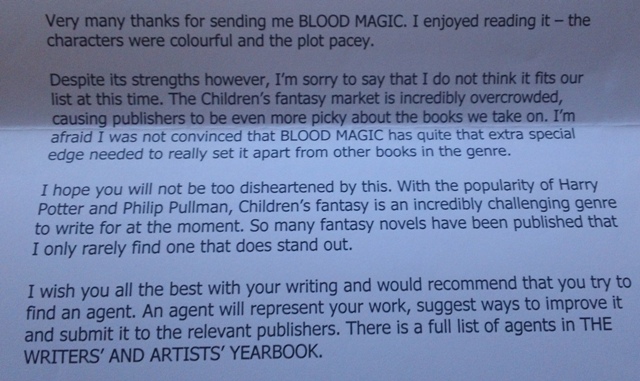
Rejection letters! While doing some spring cleaning last week, and getting rid of ten years worth of old Writer's and Artists's Yearbooks and Writer's Handbooks, I came across a wodge of my old rejection slips tucked into a volume from 2004.


I found it a really strange experience looking through them again. I felt sadness, because I remembered how each one of these rejections devastated me at the time, and I wished that I could reach back in time to myself then and say 'Don't worry - it all turns out all right in the end'. I felt kind of squirmy because in hindsight I know that the book just wasn't good enough, and I can't believe how kind people were about it. What I don't really feel is the sense of triumph I always TOLD myself I would feel, as an unpublished writer, when I looked at these letters as a published writer at long last. It's kind of like looking back at having had a nasty accident involving a lot of broken bones. You're glad you got through it and that you're all healed up now, but it still makes you wince a bit remembering.

This collection by no means represents the entirety of the rejections I got - I'm sure there's at least another couple of piles as big as this hidden in the back of my box files - but I thought I'd share these ones because they all relate to BLOOD MAGIC, which was the very first YA fantasy novel that I completed. So near, and yet - so far!


I also found a copy - and this must be the only copy left in existence, since I don't even have an old floppy disc with this - of the query letter that I sent out at the time. It doesn't seem like a brilliant query letter in retrospect, but I had plenty of requests for the full manuscript, so I must have done something right with it!


Some of the pile are form rejections, but I got a few personal comments, and I treasured these - even though, reading them now, I do wonder just HOW personal they were, and if all the form rejections looked like this!


I hope this was interesting, and reassuring, especially for those of you who are thinking about publication. Remember - the title of this blog post is true. Every single writer has got some of these, and they aren't the end of the world. Like a broken finger, they bloody hurt at the time, but after a year or so all that's left is the memory of pain rather than the pain itself. And with any luck, it doesn't even leave a scar!

Monday, 9 May 2011

WHY FAIRYTALES ARE MAGIC

(Note: This post was originally written as part of Fairytale Fortnight and posted on The Book Rat and Books from Bleh to Basically Amazing. I'm re-posting in full here in case anyone missed it the first time around. Enjoy!).

Why are some writers drawn back to fairytales again and again, even when they also write original fantasies and books in other genres, like Shannon Hale (The Goose Girl, The Book of a Thousand Days, Rapunzel's Revenge)? Why do some writers love a particular fairytale so much that they retell it more than once from different perspectives, like Robin McKinley (Beauty, The Rose Daughter, Sunshine)? Why are writers able to pull a fairytale to pieces, take the bits they like, discard the rest, put everything back in an entirely different order, and still call it a retelling, like Jackson Pearce (Sisters Red, Sweetly)?

It's because fairytales are more than just the stereotypical trappings that first spring to mind when we think about them. More than the carriages and ball-gowns, the beautiful princesses, handsome woodcutters and wicked stepmothers. More than just spells, enchanted castles, fairy godmothers and happily ever after.

Fairytales have a magical quality that is entirely separate from the magic that goes on within them. They have been passed down from mother to daughter, father to son, for hundreds of years. Like a stone staircase burnished and worn by the passage of a thousand feet, fairytales offer us a familiar path which we instinctively follow - and yet, unlike stone steps, they may take us to a different destination every time we travel them. Each successive generation has retold these stories in their own way, often pulling and warping them out of all recognition. A modern-day girl who reads the original story of Sleeping Beauty (which you can find in Italo Calvino and George Martin's Italian Folktales) would be shocked, disgusted and disbelieving to realise exactly what Prince Charming did to the sleeping princess (I know I was!).

But instead of wiping that sickening story from our oral traditions and our imagination as our societal mores and our moral standards have changed, we have brought it with us, retelling it again and again until it has become a story symbolising the strength of true love and patience and the triumph of good over evil. We can't leave fairytales behind us. Something within them is stronger than the outer trappings. Something - some universal truth - always goes on.

When I was a little girl my big sister and I fought like cats in a sack, and barely a day went by without our house being shaken by screams and complaints. One day when I was seven or eight, our mother sent us both out of the house with instructions to go to the library - TOGETHER! - and for heaven’s sake, STOP ARGUING. In tense silence, we walked the short distance to the shabby little building and went in. My sister abandoned me to browse the adult shelves. I poked around in the children’s section, and then, without much hope, looked in the Cancelled Box (where the librarians put books for sale). There I discovered a very special book. It was a large, hardback picture book, a bit peeling and worn on the outside, titled The Wild Swans. Within, children played in a fairytale castle. A wicked enchantress cast a spell. Horses tossed their manes, leopards and hawks hunted across the pages. A little girl became a beautiful woman, and wandered through a deep dark forest.

It was magic.

I would have done anything to have that book for my own – but I didn’t have any money with me or any pocket money saved up and I knew that by the time I came back, the book would be gone. It was too magical for the Cancelled Box. On the point of tears, I was about to put The Wild Swans back, when it was plucked away by a familiar hand. “I’ll buy you that,” my sister said coolly. I still don't know if she realises how, in that moment of casual kindness, she completely changed my life.

Seventeen years later, my version of the fairytale The Wild Swans was published under the title The Swan Kingdom. In my own mind, I acknowledge that very little from that beloved picture book actually made it into The Swan Kingdom unaltered. But I've read reviews which claim the story follows the original fairytale too closely and therefore lacks originality and suspense. I've also read reviews that say The Swan Kingdom is nothing like the original fairytale and that the changes I made destroy the story! The lesson I learned from these contradictory review is this: the universal truth within a fairytale is different for each person who reads it.

When I wrote The Swan Kingdom I kept all the elements which I felt were truly important to the
original story. I kept the quiet, valiant strength of the little sister, the idea of the brothers turned into swans, the painful task required to free them. I kept the idea that the heroine would be persecuted for actions which some people felt were 'witchcraft'. I kept the wicked stepmother, and I kept the handsome prince from a different kingdom with whom the heroine falls in love. Those formed the skeleton of the fairytale within my mind. But for others, my important points are not important at all. They’ve found different points of reference within the story, different ways of navigating through the landscape of fairytales. The fairytale is different for them. In their heads, it was already retold before I ever came along.

In July my second fairytale retelling will be published, and this time I've made life even more difficult for myself by picking a very well known story - that of Cinderella. The book is set in my magical version of Japan, and it's this which has most people excited about it. But the real heart of the story is the universal truth which I saw behind the trappings of the Disney Cinderella we've all grown up with. The truth that no girl, no real, human girl with a beating heart, could possibly be as spineless, as obedient, as perfect, as Cinderella pretends to be. Her perfection must be hiding something. Passion. Hatred. Intelligence. Fear. And a desperate desire for revenge.


I know that many people will be recoil from reading about a Cinderella who isn't beautiful, who isn't the slightest bit sweet or perfect, and who couldn't care less about putting on a pretty dress and dancing with the prince. Maybe people will be shocked to read about a Cinderella who lies, steals, cheats and fights her way to revenge for the wrongs done to her. A Cinderella who is broken and scarred - by her own hand. But I hope that others will see their own reality and their own universal truth reflected in my Cinderella's choices, and that in telling the story as I see it, I will allow her story to become part of the greater, timeless fairytale which mothers have been telling their daughters since before my grandmother’s grandmother was born.

That’s why writers can’t leave fairytales alone. Because fairytales ARE magic. Their magic is that of timelessness, of immortality. And by retelling them, we mere humans get a taste of immortality too.

Saturday, 7 May 2011

CITY OF FALLEN ANGELS BLOGHUNT


Heh heh. Yeah baby - we're going on a bloghunt.

First question. Have you read City of Fallen Angels yet? If YES, visit OPTION A. If NO, scroll down to OPTION B.

*
*
*
*

OPTION A. 

I KNOW, RIGHT?! Hopping Moses on a Pogostick WHAT WAS THAT? *Clutches head, takes deep breaths. Aaanyway - you want to get your hands on the letter, right? You know - THE LETTER.


The one that Jace writes to Clary in City of Glass. The heartbreaking, emotional letter where he pours out his soul to the one true love he believes he can never be with. The letter we never actually get to read in the book. I mean, I know *I* do.

So, watcha gotta do to get it? Well, it's really unbelievably simple. Here goes:

Six questions.

Six blogs.

One chance for fans in the UK and Ireland to get their hands on the letter that Jace writes to Clary in City of Glass before he leaves on a life-threatening mission.

Each question is on a different blog, and the answers lie in City of Fallen Angels, the latest in Cassandra Clare’s bestselling The Mortal Instruments series.

Once you’ve answered all the questions, put the first letter of each answer together to create a word. Email that word to Undercover Reads, and Walker Books will send you a beautiful print of Jace’s letter, complete with the Morgenstern Seal.

The second question is…

  1. What is the name of Simon’s Shadowhunter girlfriend?
Got the answer? Question 3 will be unveiled on The Overflowing Library, Sunday 8th May…

If you’ve missed question 1, start the hunt at The Crooked Shelf


OPTION B. 

Go get it. Now. If you didn't read the first three books yet? Please do, because they are so fantastic. I'm swept away by Cassandra Clare's ability to create these astonishing plots that are just non-stop action and twists and surprises and whipping the rug out from under your feet. But at the same time her characters (human and more than human) are so flawed, funny and interesting, and they change and develop and you love them and hate them. I just wish I could write books like this. *Sigh*

Okay - go have a great weekend everyone!

Thursday, 5 May 2011

COME BACK TOMORROW!


Hi everyone - and happy Friday! I know you'd normally be in for a post today, but for a very special reason my end of week post is being delayed until tomorrow. Tune in on Saturday to find out why!

Tuesday, 3 May 2011

FINAL FAIRYTALE MADNESS

Hi everyone! After Monday's serious post with so many ALL CAPS, today I thought it was time for some fluffy fairytale fun.

*Pauses while blog readers heave sigh of relief*

For a start, the Shadows on the Moon and The Swan Kingdom Giveaway is still on at The Book Rat and Books from Bleh to Basically Amazing. Enter at one or both of these blogs if you want the chance to win signed and personalised copies of these (you do want them, right? Right?). Ashley and Misty's Fairytale Fortnight feature just came to a close and guys, if you like fairytales? You must go over there and check out the amazing reviews, guest posts and giveways they've been running. I'll probably be posting the guest post I did for them here one day next week, but they interviewed and got guest posts from waaaay cooler people than me.

One of the really fun things that they organised was a Communal Bedtime story, where they got a bunch of bloggers and authors to all read a section of a fairytale, then cut all the bits together. It was a lot of fun, and there are some unexpected people taking part - so rather than say anymore, I'll just post the video here. Enjoy!


And now I'm off back to work on Big Secret Project. See you all on Monday!
Related Posts Plugin for WordPress, Blogger...