Showing posts with label Procrastinating. Show all posts

Monday, 22 January 2018

IT'S A MYSTERY

Hello, lovely readers! Long time no read and so on - very sorry about that. I can't really promise to do better in future, since having a job with regular office hours and a lengthy commute by train is definitely having an impact on the amount of spare time and brain power that I have for blogging. At least, if I want to get any actual-book-writing done (which hopefully most of you would prefer I focus on).

There is cool and exciting news that I ought to be able to share in the foreseeable future, but for now I have to keep totally quiet about on pain of getting a sorrowful and disappointed email from my agent or editor, or both. So in the meantime I thought this post - which was inspired by a tweet that turned out to be unexpectedly popular - might be amusing.

I'm currently working on my tenth novel since becoming a published writer (probably around the twelfth or thirteenth one if we're counting the ones that will reside forever in a drawer in my desk). This book is uncontracted so I can't really talk about it, except to say that it's got selkies and sea magic in it. Now get a load of this:

I have written and discarded no less than six different opening chapters for this book.

That's around 12,000 words of work that I earnestly poured my effort into and which now grace the recycle bin.

I have never, ever had to do this before - not for any other book I've written.

Let no writer convince you, my muffins, that they know how to write a book. In fact, one of the biggest differences I've noticed between the fresh and dewy just-starting-out unpublished or debut writers and the ones like me who've been hacking away at the literary undergrowth for a decade or so is that us professional hackers will admit we're never going to to figure out this writing malarkey. If a pro-writer tries to tell you that they've figured out a reliable formula for creating a book, then I can 100% assure you that they're trying to sell you something, and the something will be a book. Usually a book with the words 'How to', 'Bestseller', 'Secret' and 'Novel' in the title.

I mean, buy it anyway, if it looks fun, but don't be fooled. How To Write Any Kind of Book At All: It's A Complete Mystery To Me, I Don't Know What to Tell You is what the title ought to be.

And just to illustrate this point, here are the six discarded opening lines of my tenth manuscript, in no particular order:

1) "I always loved the water."

2) "It starts with the taste of apples, sweet and acidic, on the back of my tongue."


3) "I inhaled in as the Whisperers had taught me, slowly and deeply – one, two, three, four, five – and tried to ignore the stench of goats." 

4) "I was born Her Royal Highness Theoai Herim, the Golden One, eldest daughter of Queen Theoan, and Crown Princess of Yamarr."

5)  "Segemassa lay quietly beneath the sharp ivory horns of the rising Warrior’s moon."

6) "The sea voyage to my new home took nearly eight weeks."

And now I'm onto the seventh, which I shan't share because I have a superstitious fear that will jinx it. Wish me luck with this one, darlings!

Wednesday, 14 January 2015

WHEN BIC WON'T DO THE TRICK

Hello, hello, hello, and welcome back my lovelies! The hiatus is over. I hope everyone had a happy Christmas and Merry New Year, whatever your version of those things would ideally be. I mostly tried to relax and not stress out over all the things that TV and films and adverts try to tell you that you ought to stress out about, and I mostly succeeded, so: win.

Before I launch into today's post - which has nothing to do with the noble line of budget ballpoint pens, I promise! - I have a couple of bits of business. Firstly, I highly recommend this post by the wise and venerable Terri Windling about perfectionism and how it's not nearly as good a thing as people would have you believe. She says:
"...we're responsible for being the artist we are...not the one that someone else (or our own Inner Critic) thinks we ought to be instead."
Which happened to be just exactly what I needed to be reminded in that moment. So thank you, Terri!

The other bit of business is a lovely announcement - I'm going to be doing a panel event at the London Book Fair this year. It'll be my first ever appearance at the LBF and it's set to be FABULOUS because not only is delightful chum Liz de Jager, author of The Blackheart Legacy going to be on the panel with me, but the panel itself is coolness x3. It's title is The Dark Arts: Writing Fantasy and Horror for Young Adults, and the other panelists will be Josh Winning, and Sally Green! The panel will be on Tuesday the 14th of April at 16:00. I can hardly believe I'll get to be a part of it, and although I know that the LBF is a bit different than the YALC event at the WFCC last year, if any Dear Readers would like to come along, I'll be delighted to see you.

Now onto today's topic: when BIC just won't do the trick.

When I say BIC, I am of course referring to that well known axiom for writers: Butt In Chair. It's the idea that no matter what happens - whether you feel a bit stuffy-headed or generally uninspired or you'd really rather read the new Cassandra Clare book or spend the day arguing with that one infuriating Makorra shipper on Tumblr - when your chosen writing time comes around, you sit your rear end down and pick up the pen or open the laptop and do the thing.

Even if you sit there for the entire hour or the entire day typing the same paragraph over and over again, the theory goes, you still keep your butt sat in that chair. Because a) if you make sitting down in readiness to write a habit, your brain will soon get the idea and train you to be receptive and productive during this time, since it will realise that you're not going to give up do something more interesting no matter how it tries to distract you and b) true, elusive inspiration is far more likely to visit the writer who is already scribbling their brains out than the one who is trying to beat their high score on Candy Crush.

All of this is true, and I myself have many times advised people to adhere to BIC if they're having trouble feeling inspired. One of the first lessons that published writers learn, when the reality of deadlines sinks in, is that you can still produce decent, perhaps even excellent work, when you actually don't much feel like writing at all. And that quite often, if you force yourself through your first feelings of tiredness or sadness or just-can't-be-bothered-ness, you find yourself cheerfully plugging away without much difficulty after all.

BIC is an antidote to the much abused idea of writer's block, which is often interpreted by the less experienced writers among us to mean that if you don't feel fired up with the effervescent joy of inspiration it's totally fine to marathon Breaking Bad on Netflix until you DO. Which, no. Books don't get written that way. However, I'm not in the camp who believes that writer's block is a mythical invention of pretentious layabouts who just want an excuse to make themselves interesting without actually doing any work. I've written a defense of writer's block - or what I call writing roadblocks - here, but I make it clear that the main way to fix it is to keep writing anyway.

However, last week I had a slightly different experience, which I'd like to talk about now.

I'd been pootling away happily on BaBBook since the end of Christmas and had just written a scene which I thought was pretty darn good. I finished work for the day, counted up my words - word count for the day AND the week exceeded, hurray! - and saved everything to my flashdrive with a sense of satisfaction and no inkling that anything was rotten in the state of Denmark at all.

And then the next day I sat down to write the next scene, which immediately followed on from the one I'd completed the day before... and I choked.

(Not literally)

Despite BIC, despite picking up my pen and opening my notebook and telling myself 'Just scribble for half an hour and see what comes out', despite knowing exactly what I wanted to write, and even having been excited and enthusiastic about writing it, a tiny voice in the back of my head was basically chanting Shan't won't nope you can't make me NYER.

I was confused and upset. I hadn't slammed into a mental block like that for a long time. Normally these days 'writer's block' for me is either about a failure in planning or knowledge (fixed by a quick list of my priorities for the next section scribbled on a Post It, or a flip through my notes, reference books or, occasionally, the internet) or about some external thing, like being tired or not feeling well. In either case, now that I'm not being poisoned by my boiler I can push through it because, underneath all that, I really do WANT to write. I want to get on with things and see how the story and the characters will develop next. But not that day. That day I felt like my fingers were physically refusing to move and it was a bit frightening, honestly.

After staring at my lovely blank page for about an hour and giving myself a slight headache, I took a break. The break ended up consuming my whole day as I procrastinated like an actual, literal, professional procrastinator. I mean, it's not that I haven't previously reached Olympic levels of procrastination. It's just that this time I couldn't understand WHY. Normally I can at least diagnose myself enough to know it's because the next scene is going to be traumatic or really tricky, or just because my depression is telling me I'm rubbish and I'm afraid to prove it. But it didn't seem to be any of that. When a second day passed in much the same way and I started to get a sinking feeling of dread.

What on earth was going on?

And then, during a chat with a member of my writing group, I had a thought. The thought related to the line edit of Frail Mortal Heart which I had completed and returned to my editor shortly after New Year. Normally by the line edit stage I've read and revised the manuscript so many times that I'm convinced the whole thing is unrepentant dreck, but because of the long period in the middle of this year when I couldn't look at my computer or do much work at all (due to CO poisoning, as we now know) I was coming to this one with much fresher eyes, and I found to my surprise and delight that I really rather enjoyed reading it again.

The best part was about three quarters of the way through when two very important threads of the story suddenly melded and produced an emotional BOOM in a way that I hadn't planned out at all. I had no idea I was even aiming at that effect. I didn't know it was coming and it really hit home. The perpetrator was my subconscious - the place where true inspiration lurks, and which can sometimes make that sudden instinctive leap, transforming great craft into actual art - working away behind the scenes, nudging me to tweak and edit, take a word out here, add a line there, and eventually create a scene which brought tears to my eyes.

So I thought about my block on BaBBook and I thought: hey, maybe my subconscious is at it again, nudging me - a bit more forcefully this time - and trying to tell me something. But what? Could it really be as simple as, Just Don't Write That Next Scene? But if it was, why? And what *was* I supposed to write next?

Almost immediately, the frustrated, constipated, Shan't Won't Nope You Can't Make Me NYER feeling dissipated. My cunning back brain, satisfied that I wasn't trying to bludgeon it to silence with BIC, suddenly began to cooperate, opening up doors to some floaty little scraps of ideas that I hadn't even noticed before because I thought I knew what I was supposed to be doing.

I pondered this while I cooked an elaborate pasta dish with homemade cheese sauce (the secret is to add Worcestor Sauce, mustard, and a dash of nutmeg by the way) took the dog for a long, slow walk, and eventually popped into my writing group to discuss it while listening to calming folk music.
What if... what if rather than writing the next chronological scene right now, I saved it for later in the book? Yes, showing it NOW, in its technically correct place in the story, would be thrilling and exciting, a great piece of action before a more quiet section. But that was all it would be. The reader would certainly know that the heroine wasn't going to die at this point so there'd be tension but not real fear. In fact, this scene, which had previously seemed inevitable and almost unavoidable, would be more like... well, predictable. Maybe even a little... unnecessary?

But if I held it back, maybe teased the reader with fragments and fleeting flashes of what had happened, and jumped the narrative and the heroine forward in time... then I could keep that whole piece of action for later in the story. Then it would no longer seem predictable. Then it would not only offer the reader thrilling action but also truly great emotional impact. It would serve as something much greater than a set piece - it would be a characterisation bombshell, turning the status quo of the story on its head. It would be *beautiful*.

And what's more, if I worked it that way, many other tiny issues which I hadn't quite figured out how to tackle yet would suddenly click into place, functioning together like a well oiled watch to add to rising tension and the reader's investment. I wouldn't even have to DO anything. It just... worked that way.

My subconscious was a bloody genius.

Despite the several days delay while I worked all this out, I'm now back on target with my wordcount and, more importantly, having whizzbang fun writing the current section of the story with a twist that I had never envisaged at the planning stage. And what does all this come down to? That sometimes when you get blocked, it's for a reason. It could be for the reasons I mentioned before - gaps in planning or knowledge or because of external factors - but sometimes it's just that you need a couple of days to work out a different way, an unexpected way, a better way, for the story to play out.

Yes, I could probably, with great effort, have BICed my way through this crisis. I could have forced myself to put words down on the page. But those words wouldn't have been the right words. They'd have been perfectly fine words, no doubt, and it's not like the entire story would have failed if I hadn't come up with this nifty alternate way of working this section. But it would have been less than it could have been. Less interesting, less fun, just less good.

So although you do need to give yourself permission to suck sometimes, and you do need to remember that you can't fix a blank page, and first drafts aren't meant to be perfect... there are times when you also need to listen to the little voice blowing raspberries in your back brain and admit that your first, unthinking ideas on how to execute something might not be the only or the best way. And then let your subconscious have its say. Something to think about.

And now... SURPRISE MUSIC RECOMMENDATIONS NO-JUTSU!


Wednesday, 3 December 2014

A QUESTION OF JEDI MINDTRICKS

Hello, my lovelies! Happy Wednesday! Today's post is in answer to a reader question, but before I get started, I bring tidings of great joy! THE NAME OF THE BLADE has been nominated for the Teenreads.com Teen Choice Book of the Year 2014! Voting for the winner will run between now and the beginning of February next year, so if you've enjoyed the book and would like to see it get a little more attention head over here to the poll and voice your opinion (you can vote for up to five books, not just mine).

Also, any reviews for the US version of the book there on Amazon.com would be greatly, greatly appreciated. I know that's a pain for US Dear Readers who've already reviewed the UK version of the book, since those reviews *should* have been transferred across. But I emailed Amazon.com about it and their response was basically 'Meh'. So... it's down to us to do something about the lonely, four-review status of the book. I appreciate the readers who've already done so more than I can say. But I love you all anyway. Mwah!

Now onto today's question, which was left in the comments by Anon:
I had a quick question in which I'd like to ask if you do not mind. I was interested to find out how you center yourself and clear your thoughts prior to writing. I have had a tough time clearing my thoughts in getting my thoughts out. I truly do take pleasure in writing however it just seems like the first 10 to 15 minutes tend to be wasted just trying to figure out how to begin. Any suggestions or tips? Many thanks!
Anon, this is a problem I'm sure most writers and creative people have. I know that the fantastic YA writer Melinda Lo, for instance, needs to meditate for a short while each day before beginning work in order to centre herself. It's a little strange, because if you're anything like me you spend a lot of time doing regular day to day tasks - shopping, cleaning, walking the dog - with your brain just buzzing with your character's voices and bits of descriptions and actions you can't wait to write. But as soon as you actually sit down to do so? Suddenly your head is filled with the regular day to day tasks instead! Frustrating.

I've got an advantage because I have my Writing Cave, a teeny-tiny box room which is filled with books and a computer and pretty much nothing else. When I go in there my brain *knows* that we're about to get down to business and so I find it easier to clear my head and start work (sometimes I swear, as soon as I walk in I can feel my synapses give out a little sigh of relief). But on days when I'm stressed or tired or just not feeling all that creative, it can still be really tough to stop other thoughts from getting in the way of the words. So I do have a few strategies that I use to shove all that annoying real stuff out of the front of my head to make room for my story.

MUSIC: I'm a little more music obsessed than the average bear (although not as obsessed as the famous Maggie Stiefvater, whose eye-wateringly extensive playlists can be found all over her blog and Tumblr) and make multiple playlists for each book, and sometimes specific ones for each character or for important relationships or events. But you don't have to be a tunes-nerd to utilise the benefits of music to help you focus and get your head into a creative space! You don't even need to be one of those writers who listens to music as they work - I know plenty of people who can't stand it, but don't worry about that. That's not what we're doing here.

Set aside an afternoon to browse on Spotify or YouTube and find a song that really speaks to you - you know the kind I'm talking about, one that makes you stop whatever you're doing for a moment as soon as you hear the opening notes, that gives you a little shiver down your spine when it opens up. If it's a tune that relates in some way to your current book, that's great, but it doesn't have to be. It just needs to be a piece of music that speaks to you.

Download said piece of music and the next time you come to write, after your document or your notebook is open and you're ready to begin, stop - and play the song. Listen to it with your whole heart, feel it, let it move you. When it's finished, hopefully the buzzing thoughts will have calmed down a bit and you'll feel the stillness and inner quiet you need to start putting words down. 

PLANNING: Sometimes your head is full of anxiety and stress because you know the upcoming scene is really important and you're not sure you have the skills to pull it off. This worry can block the brain like nothing else, and before you know it your thoughts have gone off on a merry, procrastinating joy-ride, fixating on the cracks in the ceiling, the not-very-interesting thing you saw on TV last night, or your plans for great-aunt Miriam's birthday present next May: in short, ANYTHING but the thing you actually need to concentrate on.

At this point, whether you're an outliner or a pantser, a little bit of planning can really help. Not too much! Don't panic! Get a Post-It or the back of an envelope and a pencil and make yourself a little bullet-pointed list of three or five or ten things you need to accomplish in this scene. John and Beth argue/Beth storms out/John watches Beth from window and has revelation about feelings/John sees fireball fly over castle wall and immolate Beth/John screams in primal rage, turns into purple gorilla and smashes way out of window to destroy everyone. There!

You don't have to stick to this list of things - but by having defined what you're here to accomplish, you've sneakily slid your brain sideways into focus on the story in a no pressure sort of way. When  the list is finished, generally you feel calmer and better able to begin. 

TAKING THE PRESSURE OFF: Sometimes all the stars align right, the writing gods smile on you, you roll out of bed bright and early and find that you have a whole day or half day (or whatever) with nothing to do but write. No distractions, no worries, nothing else to accomplish. It's going to be amazing! You sit down. And you stare at the blank computer screen/page. And stare. And stare some more. AND NOTHING COMES OUT.

Why? Too much pressure! The idea of dedicating a whole day or several long hours in a row to nothing but writing feels exciting, but in practice it can often make your brain freeze up. So come at it a different way. Set your phone or your alarm to beep in half an hour or forty minutes and tell yourself that you need to write as many words as possible in that time. When you're done, you're done. The rest of the day is free. GO!

This might sound like the opposite of 'taking the pressure off' but it works really well. Now you have a short-term goal which is much less scary than 'spend the entire day creating deathless prose' and you don't have any time to hang around. It jumpstarts you creatively and you may find that you write a surprising amount for such a short period of time. You may also find that at the end of your thirty of forty minutes you're desperate to continue - which is fine - or that you're exhausted and happy to stop - also fine! Either way, you'll have accomplished much more than you would have if you'd spent two hours staring at your blank page before finally bursting into tears, fleeing to your favourite blankie, and curling into the fetal position. 

JUST RESIGN YOURSELF: Even with all these Jedi mindtricks, there are still times when your brain simply will not shut up and you cannot seem to get into the proper writing mood. You know that anything you write for at least the first twenty minutes is going to be rubbish.

So? Resign yourself to that and write anyway.

Just because the first few paragraphs or pages will need a lot of rewriting, that doesn't mean the rest of your work for the day won't be excellent and well-worth committing to the page. It doesn't mean you should waste hours fruitlessly trying to inspire yourself in increasingly bizarre ways, or give up completely, either. This is one of the first lessons that full-time writers learn: sometimes you just have to push through and write, even when you don't feel like it.

In almost every case, after half an hour or so, the effort to put words down loosens up my cramped creative brain and I start to feel happy and inspired after all. So what if it takes a page of dross to get me there? It's worth it!

I hope this helps, Anon! Read you next week, everyone :)

Tuesday, 3 December 2013

SOME BOOK REVIEWS

Hello, oh luverly readers. I've just realised that this is actually my 500th post on the blog! If I'd figured that out any earlier than eight o'clock last night I'd probably have tried to organise something a bit different and special, but perhaps this is more appropriate really: today, I bring you the fruits of my procrastination - ie. a bunch of reviews of things that I read while I should actually have been writing.

If the universe was fair, of course, these books would all have sucked in order to punish me for my lazy, procrastinatory ways. But instead, several of them are amazeballs of a really high order, and I thought I'd talk to you about them.

First up was Lips Touch: Three Times written by Laini Taylor and illustrated by Jim di Bartolo.

U.S. Hardcover

U.K. Hardcover
I was *so* thrilled that this came out here in the UK finally that I snapped it up for my Kobo and ordered a hardcover copy too. And then another hardcover copy for my sister, for Christmas, because I know she'll love it nearly as much as I do. This isn't a novel, but a collection of two short stories and a longer novella, and that format really allows Laini Taylor's extraordinary imagination the freedom to spread its wings. She creates three complete, fully realised fantasy worlds and populates them with vivid, complex and not-always likeable characters who each become simply unforgettable by the end of their stories. The gorgeous illustrations are icing on the cake - although I was sad that they were in black and white, rather than colour (the preview on the Kindle version of the book does show them in colour, and I believe they were coloured in the U.S. hardback too - why so stingy UK publisher?!).

Laini Taylor's writing is intoxicatingly good. It's so good that it's not possible to describe it, really, without sounding gushy and overblown - you want to throw superlatives in there like 'romantic', 'lush' and 'beautiful' but you're still not getting at just what it is that makes this story collection so special. The atmosphere it creates is utterly magical, and every time I had to put it down I felt as if I was still walking around with half my soul existing in a parallel dimension of wicked goblins, tragic curses and howling wolves. I had the sense that every line of Ms. Taylor's prose I absorbed was teaching me something, whether it's how to contrast whimsy and terror, or how to use contemporary language to understate horror, or how to let lyricism off the leash without losing control of it. My favourite of these stories is the final one, the longest, and I hope and pray that the writer may one day return to that world; although in fact any of the settings, any of the characters utilised here, could easily support a full length book. If you only buy one new book before the end of this year, make Lips Touch the one.

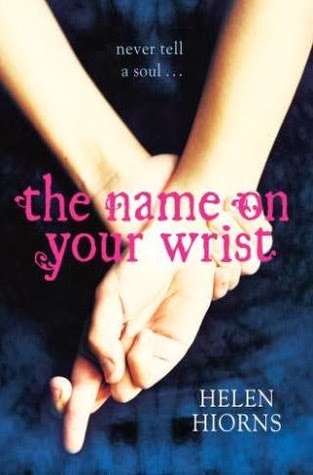
Second came The Name on Your Wrist by Helen Hiorns (this will be out on the 2nd of January 2014).


I was sent a link to an eGalley widget to this book, saw that it was about soulmates, and downloaded it assuming that it would be a nice, sweet story about forever teenage love. I probably *wouldn't* have downloaded it if I'd realised that it's nothing of the sort - that, in fact, it's one of the bleakest and most uncompromising Dystopian novels I've ever come across - but that would have been my loss. I'm glad I read it, even if it did leave me wanting to curl up under a blankie with a cup of hot chocolate and have a good cry.

This is a really remarkable debut from a very talented writer. I've never come across a PoV character quite like this, or a narrative voice that struck me in quite the same way. The writer walks a razor-edge between prose that truly does read like the self-obsessed, angsty journal rantings of an emotionally broken teenage girl, and prose which has the emotional clarity and power required to carry a full-length book. The main character, Corin, is one of the least immediately 'likeable' and therefore perhaps *most* realistic female characters I've read in ages, calling up definite echoes of Cat Clarke's unforgettable Grace in her debut Entangled. She's strong and yet feeble, angry yet vulnerable, and she's got everything and everyone all figured out right from the start, while simultaneously managing to be wrong about all the most important things.

I love the ideas in this book. It creates a Dystopian future which rather than seeming outlandish and shocking feels shockingly plausible to the point of being bland. A future in which people in power  really do seek to keep everyone safe - by making them comfortable, appealing to their laziness and desire to fit in, and making all their choices for them. Each plot and subplot is there to challenge our idealisation of romantic love as the only love that really matters, presenting a world where everyone has a soulmate, where everyone knows the name of the true love whom they will eventually find - and it's a complete nightmare.

This book's only real weakness is its ending. There's a brilliant twist, but sadly the way it's unveiled and the main character's reaction to it rather works against the messages that we've absorbed from the story up to that point. It needed further unpacking and resolving to make it as strong as it should have been. But regardless, I really admired the author of this book for making so many daring choices, and for managing to surprise me. Recommended.

Finally, Chime, by Franny Billingsley.

U.S. Hardcover

U.K. Paperback
I must be the last person in the whole world to read this, but I'll go ahead and throw my two cents in anyway. Again, I fell in love with the snarky, bleak, broken voice of our narrator, Briony - it was clear from pretty much the first page that she was an utterly unreliable narrator, but equally clear that *she* didn't know this. I love both her, and the cast of characters around her, some of whom revealed hidden depths by the end of the book - others of whom simply became more who they had seemed to be at the beginning, which I thought was a nice touch. In real life, after all, some people really ARE just exactly what you think they are when you first meet them.

One of the great strengths of the book, aside from that marvellous Briony voice, is the setting of the Swampsea, which felt completely real to me as someone who lives on the edge of a boggy saltmarsh. I also loved the richly textured, tattered backdrop of myths and fairystories and legends - many of which, of course, turn out to be frighteningly real. At times the town setting felt a bit threadbare in comparison, with scenes that could/should have been colourful and lively, such as Briony's fight in the town square ending up feeling a bit 'talking heads'. I wonder, actually, if that was a conscious choice on the part of the author, making the magical swamp feel much more real by comparison.

However, once again I felt that the ending of the novel let it down. Without giving away spoilers, a certain character abruptly acts in a way that completely changes our understanding of who he is - and then proceeds to blame it on Briony (who is far too ready to take the blame, as we've seen throughout the entire book). This scenario feels entirely familiar to someone who's read about rape culture, as does the fact that this male character's pain over what he's done is treated as far more important than the heroine's pain at he's done to her. He's instantly forgiven so that the story can have a conventionally happy ending. All this left me feeling betrayed and bruised on the heroine's behalf. I think I can understand why that scene was there and what the writer intended - to shed a light of human frailty on a character who might otherwise have seemed too good to be true - but the method used and the pat wrap-up just didn't work for me, and nearly ruined an otherwise brilliant story.

I think I'd still recommend this, but with a trigger warning that there are problematic elements.

So! What have you guys been reading lately? Give me your recommendations in the comments, my muffins.

Tuesday, 15 January 2013

HEROINE ART

Hello, everyone! Today's post comes to you via Diana Peterfreund's latest blog. I defy anyone who has EVER written a story with a heroine to resist the procrastinatory delights of the Heroine Generator game. YOU CAN'T DO IT. Copyedits? Deadlines? Pffft. LOOK AT THE ADORABLE SELECTION OF ACCESSORIES!!!11eleventy.

Ahem.

So I used the website to generate art for each of my heroines. Guys, this is possibly the most fun I've ever *had* picking out clothes. It's insane. Anyway, I present to you... My heroines!

Alexandra of The Swan Kingdom! Note her fancy dress with lacy bits, which has been patched up due to living in the forest with all those cute little animals, plus the rolled up sleeves to allow her to forage for food. I think her hair was probably a bit wilder than this, but I didn't want to end up with her looking like Merida from BRAVE.


Zira from Daughter of the Flames! Again, hair is a bit tidy - plus they wouldn't let me scar up her face. BUT BUT! Doesn't she look like she could kick your butt so comfortably in this outfit? I *want* this outfit. Yeeees.
Suzume of Shadows on the Moon - or rather Yue, in her fancy incarnation. She's all dressed up for an important do and looking forward to it about as much as I look forward to extensive dental treatment, as you can tell from her expression. Poor Yue! This outfit isn't the slightest bit historically accurate, or even accurate to the book, but it sure was fun to play with.
Frost! The heroine of FrostFire. She's in her mountain travelling get-up, here. She's a bit clean and tidy (this is a recurring theme for me, isn't it? I do torture my poor creations rather a lot) but I think her wary expression is spot on.
My final piece of artwork - Mio, heroine of The Night Itself and the best of The Name of the Blade trilogy. Isn't she CUTE? You'd never realise that she's hiding a deadly weapon somewhere on her person, would you? I totally have a crush on my girl after working on this. I can also tell that her best friend Jack helped her pick out everything she's wearing here, because black and purple are Jack's favourite colours. I wish Jack was my best friend, too...
And now, I bid you farewell, although I'm pretty sure that you're all already rushing off to generate your own artwork anyway. In the meantime I'll go back to my copyedits. In about five minutes, once I've finished this last piece of heroine art...

Tuesday, 11 December 2012

NOBODY WANTS TO READ THIS...

Hi everyone - happy Tuesday to you all. Today I'm writing a post that I'm pretty sure no one is going to want to read, but I've been wrestling with it for the past couple of weeks so...here goes.

I go through different phases with my blogging. Sometimes I have so much to say that it's a struggle to hold myself back to two posts a week. Sometimes I get a great idea and come up with one really decent post in a week and then find the tank empty - and thank heavens for Retro-Thursday/Tuesday! And sometimes - more rarely - I just struggle to come up with any time or attention for the blog at all. When that happens I know that the blog suffers and feel horribly guilty about it.

I've been going through one of those latter phases for about a fortnight now. It's been a fight to come up with interesting blog topics, but even when people on Twitter helped me out and made suggestions or asked questions, I didn't seem to be able to make anything substantial from them. Right now, just writing this, I'm grumbling and moaning as if I was back in school trying to come up with an answer for a particularly tricky exam question. It's not flowing, and I'm not having fun.

Maybe it's because I'm starting Book #3 of The Name of the Blade and there's a lot of anxiety and stress in my head. Maybe it's because things are going on with my dad at the moment - he's going into hospital for a heart operation this week - and I need to be there for him and my mum. Maybe it's just because everything's dark and cold and some instinctive part of me wants to hibernate.

In the past I've struggled through these dry periods, posting as usual, and trying not to face the fact that the quality of the blog has dropped. But this time I don't want to do that. As I've said above, it makes me feel guilty, and then that takes what little fun is left out of the process. So I've decided to try something different.

A blog hiatus. A proper one. Not a one week break from the blog while I'm on a deadline or on holiday, like I've done before, but a temporary stop in blogging activity which I think is going to carry me through Christmas and up to the New Year.

I'll still pop my head above the parapet and post if something important occurs to me to say. I'll update you if I get any exciting news. But other than that I'll be giving the blog a complete rest, and the regular posting schedule will not be followed.

I'm hoping that if I do this, by the time the 1st of January rolls around, I will have a whole cauldron full of ideas bubbling at the back of my brain, and I'll feel rested and refreshed enough to do those ideas - and my Dear Readers - justice.

So for now, I'll wish you all a very Merry Christmas, and offer my best wishes for the most wonderful New Year. Read you later, guys,

Thursday, 25 October 2012

A QUESTION OF INSPIRATION

Hello, my lovelies! Thursday has crept up on us here at the blog again and it's time to answer a question from the delightful Isabel, long-time blog commentor. She says:
I have a question for you that I couldn't really find in the "all about writing" section. I don't know if it's a problem with me or my story, but recently (like the past couple of months or so) my creative juices have sort of stopped. I've been able to write stuff, but it doesn't feel quite right, because I'm not as into it. Is this just writer's block, or something bigger, and have you experienced it before? Is it maybe a problem with the book I'm working on? I know that you've talked about periods in your writing life when you've felt really uninspired, so I thought you'd be the best person to go to about this.
OK, so here's the thing. You're a busy student and you have a lot of lessons and homework and extracurricular activities that you're pouring your time and your creative juices all over. Writing is only one of the things that you try to cram into your day. It's very natural that sometimes you don't quite have enough creative juices left to give you that sense of inspiration for your writing.

If you are not enjoying what you're working on right now, or something feels off no matter what you're writing, there's always the Take a Deep Breath post for ideas on how to get your fun back. But at the end of the day, for you, Isabel, writing is a hobby. Forcing yourself to do it if it doesn't feel right is the last thing in the world that you should do. Enjoy having the luxury of being able to put your incomplete stories aside to work on other things, or just to read or listen to music or lie around daydreaming.

BUT -

(and this is a big but)

If you do intend to become a professional writer one day (which you may, or may not intend to do right now, and either way is fine!) you will need to get used to writing without inspiration.

A lot.

I mean, like, about 50% of the time. If not more.

When you (this is the plural 'you' now, addressing all the Dear Readers) do this for a living you're probably writing five or six or even seven days a week. On a full working day (a day when I'm not looking after my dad, or being forced to do housework and chores in order to avoid living off pickles and stale bread in a pigsty) I probably start work between 9:00-10:00am and write until 1:00. Then I have lunch and take my dog for a walk and usually get back into my Writing Cave at around 2:15. I carry on writing until 5:00 or 6:00 or, some days, 8:00 at night.

Of course, when I say 'writing', what I actually mean is 'trying to write'. And that might include making notes, researching, doing outlines, or even dropping onto Twitter to cry about my pathetic wordcount and be patted on the head by Twitter Pals.

But even so? That is a lot of hours. There is no way anyone could expect to be inspired for that many hours a week. It just isn't possible.

Here's what I've learned from being a full-time writer (although I've kind of already figured it out before that - being full-time just made it a certainty): you don't need inspiration to inspire your readers.

Yes: you need a spark to bring the story to life in your head. Yes: the days when you are lit up with creative fire are fun and wonderful. Yes: we all LOVE inspiration and wish we had it more.

No: no one can tell the difference when it comes to reading your work.

Trust me. Pieces of writing that I hated, that felt like they were dragged out from under my skin one word at a time with splinters of bamboo, have turned out to be my editor's favourites. Pieces that almost wrote themselves with no input from me, in a blaze of perfect inspired beauty, ended up being ripped apart and completely re-written or even cut all together.

Here's a fact that many people (up until now) didn't know. FrostFire, the Daughter of the Flames companion that came out in the UK this year? I wrote about 99% of that without feeling inspired at all.

I loved the story, I loved my characters, I loved my setting. I wanted to write it. I was passionate about it. But for some reason (maybe because it was my first book written as a full-time professional) once I actually started to put words on the page, build scenes, create a story? Every feeling of intuitive, natural, smooth writing just dried up.

I still went into the Writing Cave every day and produced 2000 words. Because I was under contract and everyone was waiting for this book and that was my job and the story was never going to get finished unless I just put one word after another until I reached The End.
  
Now, most books are thankfully not like that. But no book I've ever written has been the product of 100% inspiration. Not only do you have to write on days when it feels like you'd rather stick a fork in your eye and swirl it around, but afterwards, when you've submitted the manuscript, your agent or editor (probably both) will come along and ask you to write new scenes in order to fill gaps or resolve plot threads or improve the development of relationships, and of course those are going to come out of thin air too.

The point is that even without inspiration, so long as the words still come, then that's OK. No, it won't necessarily be as much fun, but provided you still do your best and revise and edit in the same way, no one but you will ever be able to tell which chapters were a slow painful slog to write and which were lovely, inspired joy. No one will even care.

FrostFire is my editor's favourite book that I've written so far. My mum thinks it's the best thing I've ever done too. I honestly don't think that it would have been a better book in any way if I had written it under the influence of The Muse, even though it would probably have been a lot more fun here in the Writing Cave.

So my advice to you, Isabel: keep writing if you really want to tell that story and see how it all turns out. You're not 'selling out' or doing anything wrong by not writing only in a blaze of inspiration. But don't make yourself miserable or force yourself to write it you're hating it either.

You only have to do those things when someone has paid you. *Sigh*

Thursday, 26 July 2012

THE STATE OF THE WRITING CAVE

Today's blog title comes from the 'State of the Nation' address made by the President of the United States. Obviously the work that goes on in my Writing Cave is far more important than running a country or whatever, so I thought I'd flatter that poor Obama guy with some imitation. It'll make him feel important.
Aw. You can tell he's moved.
Anyway! Happy Thursday to all. Since the FrostFire Blog Tour is now officially over we're back to our regular posting schedule of Tuesday and Thursday, and it seemed like a good time to update you on what's going on around here and what I'm working on.

So back in this post I told you that my editor decided to do a sort of awesomeness-overhaul of The Night Itself (Katana Trilogy Book #1) at pretty much the eleventh hour. Working on that has kept me extremely busy for a large chunk of time (and I went through four highlighter pens. Dude) but I finished the initial - and hopefully most difficult - revision and returned it to my editor. She's going to collaborate on marking up the new version of the manuscript with my U.S. editor, because Walker and Candlewick have been working closely together on this project in the hopes of reducing the wait between the book coming out in the UK and being published in the U.S. I probably won't hear anything back about the improved version of The Night Itself until late August.

I imagine there'll be another run through of the book then in order to smooth it and polish it and make it as good as possible. I'm really crossing my fingers that I'm not asked to make any more major changes, re-think any characters or add any more new scenes at this point. Not because I don't want to do the work on TNI, but because I'm obviously trying to work on the second Katana Book (which does have a title, promise - I'll probably share it when I have a cover design for The Night Itself to show you). Before I was asked to revise the first book I was about 65,000 words into the second one, which I expected to be about 73-80,000 words long in total.

With all the changes that I made to the first book, the second one now not only needs to be finished, but also completely overhauled itself (above and beyond the normal revision process) because in many key areas it no longer matches the first book, and THAT means large chunks of action and plot and characterisation no longer make the slightest bit of sense.

The problem is that because I'm not entirely sure if the new version of the first book that I've turned in will be the FINAL version (or if I'm likely to have to make more radical changes) I don't really know how to overhaul book #2 yet. And it's hard to imagine being able to push on and finish it without overhauling it, knowing that everything I'm writing is most probably fundamentally *wrong*.

I've got a fat manuscript of the incomplete second book printed out here, in a smart plastic document holder. It's been my constant companion for the past few weeks, but I've not yet been able to bring myself to open the holder and look at it because I literally have no idea what to do with or to it. Not to mention that printing it out breaks my Number One Cardinal Rule for myself when I'm writing, which is DO NOT LOOK BACK.

Looking at any part of an unfinished manuscript has been known to cause total paralysis in my writer's brain (accidentally reading a page from the beginning of the first draft of Shadows on the Moon caused writer's block that lasted for SIX MONTHS). In this case I know I have to re-read the manuscript before I go on. There's no way I can move forward with it otherwise. But that doesn't stop my whole brain from lighting up with red flashing signs saying DANGER! DANGER WILL ROBINSON!

So... *Sighs* I've basically spent the last few weeks grinding my teeth and procrastinating to the utmost extent of my ability. Which is great. Finally acknowledging that I've also been ill for a bit (once again, kids: denial doesn't work like antibiotics!) and getting some pills has helped, because it's made the headaches, dizziness and constant nausea (which my mother insisted was caused by stress - thanks mum!) go away and now I feel slightly better. I think I'll most probably bite the bullet and try to start re-reading this weekend. Eeep.

In the meantime! Remember the Summer Scream Event in London on the 4th of August, at Foyles Bookshop at Charing Cross? Where I will be part of a panel event also staring mega-stars L.A. Weatherly, Karen Mahoney and Michelle Harrison? Well, now some new authors will also be coming along to take part in a second panel event - Ruth Warburton and Laura Powell. And this is happening - Good Lord - SATURDAY NEXT WEEK! Where did the time go? I'm getting more and more excited the closer it gets. I'll probably do a post about it on Thursday next week, just to give a bit more detail for anyone who is coming - and I promise to take pictures and write up a detailed event report on the Tuesday after I come back so that even if you couldn't attend you'll get a flavour of the whole thing.

My publisher has been kind enough to get me a later train back from London on the Sunday and I'm hoping to use that time to do some Katana Trilogy research, specifically for locations I'm planning to use in the final book, which is brilliant and I'm really looking forward to it. It will, of course, be even more brilliant if I've managed to un-chicken myself and re-read Katana #2 by then. Wish me luck with that...

How are things with all of you, Dear Readers? Unload in the comments!

Thursday, 15 March 2012

MY LATEST ADDICTION

Happy Thursday, Dear Readers! Today I'm going to introduce you to my latest addiction/guilty pleasure/procrastination device:

Pinterest.

Oh, so much pretty! So, so, so much pretty, Dear Readers!

Ahem.

So, yeah, after seeing that lots of authors were using the site to build up mood and inspiration pinboards for their books, I got overexcited by the pretty caved into temptation and begged on Twitter for someone who already had an account to send me an invite (which you need in order to sign up). A very, very kind gentleman writer did the honours, and soon I was setting up my very own visual inspiration boards.

Now, I've posted the odd picture here on the blog in the past to give you a flavour of what I might be working on, but I'm not sure you guys fully realise the extent of my magpie-like obsession with Teh Pretty. I haven't even uploaded a quarter of the pictures from my files onto Pinterest yet, but it's really satisfying to see the images that I've collected over years organised and together on screen like that. The only thing that makes me sad is that you can't, as far as I can see, pin sound files or videos - which are another enduring source of creative fuel - to the board. Maybe they'll change that in the future.

In the meantime, here are the links to the boards I've currently got running.

Katana Trilogy

Barefoot on the Wind

General Inspiration

And to make up for the fact that there's no music included, here:

Thursday, 15 December 2011

RETROFRIDAY: WRITING ROADBLOCKS

Happy Friday, Dear Readers! We made it to the end of the week - which probably seemed impossible somewhere around the middle of the week - so let's all have a pat on the back. Now the time has come for me to delve deep into the cool, secret shadows of the blog archive, emerge with a dusty old post, give it a quick polish with a damp cloth, then pop it onto the dinner table so that new readers can experience its delicious vintage, and long-time readers can sip of its rich sweetness once more. That's right! It's RetroFriday!

The topic of writing roadblocks was inspired by regular commenter Megha, who asked me a couple of separate questions in various comments, which I've smushed together to make this:

"Do you ever feel that your plot is too... big? Too much? I'm scared of starting my novel. It has been planned and plotted properly, and now I'm too scared to start. It's not writers' block, I know. And I know that all the writers go through this. My planning's done. There's nothing LEFT to plan about. I need to start, but I can't."

This is a writing roadblock.

Megha is right - this does happen to most writers at some time or other, for various reasons. In my case I'm usually scared the story is too SMALL, rather than too big. I worry that not enough happens, that I haven't made the right choices to stretch my characters, that I'll just run out of stuff to write after 30,000 words. I worry that it's all flawed because I've missed some huge, vital conflict that would have made everything worthwhile. Hence this Post-It stuck in the first page of my FF notebook:


But being scared that the story is too big, that it's too ambitious, that you won't do it justice, that it'll be too long...those are crippling fears too (I know, 'cos that's The Scary Place I've posted about here, and which I usually enter at around the 50% mark of my manuscript).

These roadblocks are hard to break through specifically because they don't come from the logical part of your brain. They're not based on anything you can put your finger on. They just appear out of nowhere, causing a nebulous sense of dread that makes us feel we'd do anything, even scrub the bathroom clean with a toothbrush, to avoid actually writing.

This isn't about writer's block in the sense that I think writer's block normally has one of several concrete causes (which you can read about here). This is basically about your own fears, your conscious and unconscious worries about writing, getting all snarled up and taking all the fun out of everything. And there's only one cure. One way to kick that writing roadblock to the curb.

If you've read many of my writing posts before, you probably know what I'm going to say next.

The one way to destroy a writing roadblock is to write.

It will NOT go away on its own. You won't wake up one day and find it's miraculously evaporated. You may wake up on many mornings thinking 'This is the day! Today I will write!' and then find yourself making excuses, procrastinating and pottering until it's midnight and you need to get to bed, but that's obviously not very useful. You will never be able to escape the sense of horrible foreboding until you punch through it and actually write. And the longer you leave it? The harder it gets.

I know it's horrible! Believe me, I know! But taking charge is the only way.

HERE'S WHAT YOU NEED TO DO:
  • Put the plans/notes/story outlines/folders of maps you've made for this story away.   
At this point you're using these as an excuse to avoid writing. They've become part of the problem. Put them at the bottom of the draw. You are forbidden to look until you actually NEED to check a fact or remind yourself of something. 
  • Leave your normal writing place. 
If you've been sat in the same room in the same chair, or lying on your bed, or sat at your desk, every day, stewing over his for hours at a time, your brain has now incorporated the location into your sense of dread. Go somewhere else. Somewhere you would never normally associate with writing. A new coffee shop. A corner in the library. A friend's house, if they can be trusted to leave you alone. I find trains very good for this, personally. Anyway, chose a place and go there. 
  • Set yourself a time and stick to it. 
Tell yourself that you will start writing at precisely whatever-o'clock and that you will write for a certain, set amount of time. Make it manageable. It's no good saying you'll get up at 6:00am and write for three hours. You'll fail and feel even worse. Give yourself a reasonable start time, and a reasonable writing period. Half an hour is a good stretch to start. 
  • Remind yourself that you're just scribbling. 
You're just writing to fill up the blank page at this point. It doesn't have to be great. It doesn't even have to be good. I find it useful to use a pencil and paper when doing this, because it looks messy and smudgy and reminds you that it's just scribbling, not actual writing. But if you normally write with pen and paper, maybe you'd want to switch to a laptop, so long as you're okay taking it with you to wherever you've chosen to write.


That's all. 

As soon as you've started writing again, as soon as you've defied the dread and the worry and the stressing-out and put pen to paper for fun again, you remember why you actually wanted to do this writing lark to start with.

Don't go too fast - don't put pressure on yourself when you start to feel better. But don't let yourself off the hook either. Keep doing your half-hour scribbling sessions until you get to the point where you're starting to over-run, to not want to stop. Then stretch yourself with forty minutes. Maybe think, 'Today, I'm going to use my forty minutes to play around with opening lines. Opening paragraphs for the first chapter. Hmmm...'

Then one day you'll find you've written for two hours straight and that you've got a first chapter staring at you.

Writing roadblock? Dust.

Right - time for me to get back to my precious. Hope this was helpful everyone - and have a great weekend!

Wednesday, 28 September 2011

THE LOVE THAT KILLS

Hello Dear Readers, and welcome to another delightful Wednesday on the Zoë-Trope!

Today I'm going to talk about love. And not just any love. The deadly kind.

I am not referencing here the sort of feelings that a slender brunette who has never quite fitted in instantly and inexplicably develops for the marble cupcake Adonis who wants to follow her around and watch her sleep and also rip out her throat and chug down her florally scented tastyblood. No.

I'm talking about this: R.J. Anderson's comment about beloved scenes on Twitter.

R.J.'s Tweet yesterday got me thinking about this kind of love. The love that a writer has for her work.

Well, obviously not all of her work, since about 50-90% of the time that you're working on a first draft you're likely to be under the impression that you are trying to chip the words out of solid granite by hand, with only a blunt spoon for assistance.

But there are...certain scenes, aren't there? Scenes that are just a little bit special to you. Often these are the scenes that presented themselves to you right at the beginning of your thinking process about the story, and which made you go: 'No way! That would be SO. AWESOME. And COOL! It would be Awesome with a side of Cool Sauce!' and thereby motivated you through coming up with an actual plot and setting and characters.

In fact, scenes like this are what motivate us through all those bits with the granite block and the blunt spoon. We tend to think about them wistfully, imagining all the ways that the AwesomeCoolSauceness could play out. What if the whole place just exploded? What if the hero literally bounced right off the wall? What if there were, like, shooting stars omg?

These beloved scenes become a kind of comfort blanket for the frazzled writer, I think. Sure, sure, this scene that we're writing now sucks with the force of a thousand black holes. Sure, sure, that last chapter was about as convincing as a politician promising 'change' (ha ha). But AwesomeCoolSauce Scene will be different. It will go exactly to plan. It will blaze off the page with all the beauty and intensity of the very first time you snuggled a kitten. Dammit, AwesomeCoolSauce Scene WILL BE PERFECT (Writer Hulk Smash!).

Except...yeah. No it won't.

I have a very good friend who is working on a book at the moment. She's completed several stories before and has always been interested in the craft of writing, but this manuscript is different. It has caught her imagination and her love in a unique way, and for the first time she's seriously talking about seeking publication. I'm very happy about this, because, having talked to her in great depth about the story and its characters, I'm convinced that the book is going to rock the world's socks. However...

My friend is having trouble with her climax.

Right since the beginning of her ideas process with this book, she's had a plan for how the story and characters were going to resolve themselves. She wasn't perfectly sure how she was going to get there but she did know, with crystal clarity, just how it was all going to end. And for a long time that that knowledge motivated and inspired her. But now it's become like a brick around her neck. Every time I talk to her she's this close to launching into the climactic scenes, and then the next time we speak she's all downhearted because somehow she wrote and wrote but just didn't get there.

Her writerly brain has now invested this scene with so much importance, so much significance, that any attempt she makes to actually write the thing just seems wrong and terrible and off. So subconsciously, her brain is forcing her to swim against the tide, words stretching out in front of her as she frantically paddles but never gets anywhere.

You might think that I would have some sort of handy-dandy advice to offer my friend, to quickly and simply extract her from this fix. But unfortunately I am by no means standing on any kind of creative high ground when it comes to this issue. I was in a very similar position when I was writing FrostFire. The whole book had always been working towards a certain outcome, and this outcome had never altered despite me rearranging the entire plot and giving all the characters a sex change multiple times.

As a result, the climax to my story had grown in my head until it was - had to be - the most heart-rending, beautiful, perfect climax to a book that I hadeverwrittengodammit. I got stuck in the preceding scene for over a month, completely unable to move forward. How do you start the most beautiful, perfect climax to a book that you haveeverwrittengodammit? HOW? What is the most beautiful and perfect first line? First word? I was paralysed by the weight of responsibility - paralysed by my desperation to not mess up this beautiful and perfect scene.

Eventually, some very strange tactics got me through the block. Like, taking a cold shower in the middle of the day and writing in my towel with wet hair and eating about four bars of chocolate as I typed until I felt sick, kind of tactics. Frankly, I don't recommend them.

Here's the nub of the matter. The thing that paralyses us because we cannot bring ourselves to admit it. The truth about AwesomeCoolSauce Scene. No matter how much we agonise over it and visualise it and long for it, we will never actually write it.

That's right. AwesomeCoolSauce Scene is never actually going to exist anywhere but in your brain. The moment you start taking those awe-inspiring, beautiful and perfect ideas and start pinning them to the page with words, some of their awe-inspiringness and beauty and perfection will, by definition, evaporate.

I'm willing to lay my life that no writer in the history of the world - not Shakespeare, not Dickens, not Yeats, not Austen or Bronte or Jones - has ever managed to write their AwesomeCoolSauce Scene. I'm willing to lay my life that they never even managed to write that beautiful and perfect first line, or even a beautiful and perfect first word.

But does that mean that we, as readers, don't look at their words and feel completely transformed by the beauty and perfection of their words and lines and scenes? Does that mean that we cannot and will not yell: 'Holy Cr*p, this scene is So. Awesome! It's so cool! It's AWESOME WITH A SIDE OF COOL SAUCE!'

HELL NO.

And by torturing ourselves into a small, gooey puddle with the idea of our impossible perfect scene, we are depriving our potential readers of the chance to read THEIR perfect scene.

So what to do?

Well, here's what I've learned (and if other writers reading this have solutions of their own, please feel free to chime in there in the comments): 
1) You can distract yourself from the responsibility of writing AwesomeCoolSauce Scene by making yourself hideously uncomfortable as you write. But, like I said, not really endorsing that one so much.
2) You can try to fool yourself by saying 'I'm not actually writing AwesomeCoolSauce Scene here. I'm just practising. Scribbling. Making notes. That DOES NOT COUNT!'

3) You can go the other way and outline the Hell out of this scene, using coloured pens, bullet points and a graph so you know exactly what to do, right down to where the characters have to stop to breathe. This gives you a sense of confidence going in, even if you diverge from the outline as you write.

4) This one is a complete last resort for me, because I am hopelessly linear in my process. But of course, if you feel AwesomeCoolSauce Scene hanging over you like a threat the closer you get to it, you can always skip ahead and just write that sucker so it's not freaking you out anymore.

5) Try coming at the scene from a different perpective, like writing the first part from a different character's POV, even if you've no intention of using it in the final version. It might help you to avoid the intensity of knowing it. Must. All. Be. Perfect.
In closing - loving the idea of a certain scene and using this to motivate yourself = good. Loving the idea of a certain scene so much that it literally kills your story (or you, from pneumonia) = very bad. Stay safe, kids!

Friday, 26 August 2011

WAKE UP AND SMELL THE REAL WORLD #2

Happy Friday, Dear Readers! Today, I bring you a follow-up to last week's post on diversity in fantasy.

First of all, I urge you to read these very interesting posts - the first one about about the movie business, and how film students, even film students who were not male, not able-bodied and not white found themselves caught up in responding to headshots of potential actors a certain way. Then there's this response, which isolates the fact that when you try to point out other people's unconscious prejudice, you're often accused of prejudice yourself.

As both these posts point out, the warped view of the world we're all presented with near-constantly by the media mixed with human instinct to 'type' other people according to difference means that none of us - NONE OF US - is free of unconscious prejudice. Imma say that again. NONE OF US. I'd put sparklers around that if I could. This is important.

I freely admit that I'm not free of prejudice. That's not a big admission to make because NONE OF US are. What matters is to be aware of this fact, and willing, when you have a response to something, to examine it and be honest about where that response comes from.

Let me elaborate. What is the usual reaction among your friends and family if you hint that something they have said or assumed may spring from prejudice? Any suggestion that they are not perfectly liberal, prejudice free, shiny-bright and unbiased? I bet it's defensiveness and anger. 'I'm not a racist/sexist/ableist/homophobe!' they cry, their brains filled with images of Neo-Nazis, evil, sweaty monsters, and vile, chuckling villains. 'How can you SAY that about me?' They don't listen to what you've actually said. They only react to in order to repudiate it.

Anger and defensiveness are a really good warning sign - because people only get angry and defensive when they have something to defend. That 'something' is their own image of themselves, the comfy assumptions that allow them to walk through the world feeling content with who they are. They know they're a good person, not a hateful, chuckling Neo-Nazi. Therefore they cannot be a racist/sexist/ableist/homophobic.

Except that they probably are.

I am. Every prejudice that those angry, defensive people have? I have too. They lurk there in the back of my mind, pretending that they're 'instinct' or 'common-sense' or 'realism' when actually, they are just bigotry.

That doesn't make me a horrible, hateful, chuckling Neo-Nazi. It just makes me not perfect. That's all. A work in progress. A person who is willing to be honest with themselves and the world.

And in admitting that, I become a far more able to recognise and reject prejudice than I ever was when I was striding through the world in my insulated bubble of I'm-A-Good-Person ignorance, refusing to admit that my actions could *possibly* be influenced by evolutionary imperatives to reject those who are different, and centuries of religious and secular bigotry, and a mass media who refuse to represent the world as it really is.

The moment you let go of that image of yourself as a perfect, shiny-bright Good Person who couldn't possibly harbour prejudice, is the moment you will begin truly working AGAINST prejudice. Honesty is the key. Honesty is the thing that allows you to confront your own ingrained assumptions about other people and then put them aside so that you can act, as much as possible, as if you were NOT prejudiced.

Try it. Go ahead. It doesn't hurt, I promise. Take a deep breath, and then say, out loud: "I am not perfect. I am flawed. I have ingrained prejudices. I will do my best to recognise and overcome them."

Doesn't it feel like a weight off your chest? To admit to yourself that you don't have to be perfect, that it's OKAY to have nasty, knee-jerk reactions to things, sometimes, so long as you're willing to make sure no one else suffers as a result?

Now that we've gone there, I link you to this post, which was prompted by the original Wake Up and Smell the Real World post, and which in turn prompted THIS post.

And the reason that response post is crucial? Is that as a creative person who tries to embrace diversity and who writes about a lot of characters who have experiences and come from backgrounds nothing like mine, I'm going to make mistakes. I'm going to write characters or create plots or situations that rub people up the wrong way. Some of those reactions will come from people who've put up with bigotry all their lives and who are just godammned sick of tripping over everyone else's privilege. And they're unlikely to give a flying pamplemoose about my ongoing project to kick bigotry in the behind. They're just going to say 'YOU SUCK' and walk away.

And that's OK. That's really the whole point of this post. It's not anyone else's job to educate me, or give me a pat on the head for trying really hard.

The correct response to having someone notice the fact that, despite my endeavors, I'm still flawed and unconsciously prejudiced, is NOT to flee back into the I'm-A-Good-Person bubble, claim that the ones telling me I suck are horrible, nasty, ungrateful and prejudiced themselves, and say sulkily: 'Fine! I'll just write about straight, white, able-bodied people from now on and THEN YOU'LL BE SORRY!.

Nor is it to curl into a ball on the floor, weeping, and bash my head repeatedly on the tiles chanting: "I am a terrible, horrible, no-good bigot who should be flayed UNTIL SHE IS SORRY!"

It's to listen to what other people have said, acknowledge that those reactions to my work are valid and true and real, and then decide if I can learn from them. Don't get me wrong. It is hard. But it's necessary. Because, I'm coming to realise, it's not enough for writers (or actors or artists or politicians or firemen or teachers or dog-walkers or CEOs) to write the change that they want to see in the world.

We have to BE the change we want to see in the world, and keep on being it, even knowing that we'll never be perfect - only better than we were before.

OK, I've been rambling on for a while here, so let's sum up. In order to fight prejudice in our day to day lives, we must:
  1. Step out of the I-Am-A-Good-Person bubble and admit that we are imperfect and flawed and prejudiced, like the rest of the world
  2. Be honest with ourselves when we say or do something as a result of prejudice
  3. Accept that fighting against prejudice is our own responsibility and our own choice and that no one owes us gratitude or enlightenment as a result
  4. Allow other people to tell us when we mess up without dismissing what they feel or fleeing back into the IAAGP bubble again, or trying to drink bleach because we STILL aren't perfect
  5. Rinse. Repeat.
 Does this make sense? I hope so. Honestly, you guys are better than a therapist! Let me know what you think in the comments.

Wednesday, 17 August 2011

TO CHOP, OR NOT TO CHOP?

Hi, everyone. Today's post comes to you with the sponsorship of Bleugh, God of Making People's Eyeballs Fall Out, who has been gleefully tormenting me since Tuesday. I've managed to keep my peepers in my skull thus far, but it was touch and go a few times.

But don't worry! Despite the imminent expiration of my eyeballs I still bring you a profound and deeply important post today. A post which may one day be looked back upon as a landmark in the history of the Western world. A post which could change the course of life as we know it.

Guys, I need you to tell me if you think I should cut my hair.

You may remember that back in April I cut my nearly waist-length hair to a much shorter (but still quite long!) layered cut with a fring (bangs, for the USians). So I went from this:

To this:


Now, my hair is very fast-growing, which means it's already a couple of inches longer than that again, but you get the idea. So I need to know if you think I should go from THAT (more or less) to this:

*
*
*
*
*
*
*
*


Clearly, I am not referring to transforming into a golden-skinned, perfectly groomed Goddess, but merely to being a person with a shoulder-length bob.

ETA: There has bee much useful discussion in the comments. To that end, I offer a new option, thusly:

*
*
*
*
*
*
*
*


The proper short bob. This was how I wore my hair for a very long time, and I do have nostalgic feelings about how easy it was to wash/dry, although it did mean styling every day since you can't get away with scraping it up if you're having a greasy/frizzy/general bad hair day.

I'm going to put a poll in the sidebar, so please let me know what you think. To chop, or not to chop? That is the question...

Wednesday, 18 May 2011

WRITER'S KRYPTONITE

Hi everyone - congratulations on making it through the week this far. It's been tough, but the worst is over now, right? We can totally survive until Friday. Totally. Right? Probably. Heh heh. Ahem.

Why the patently false cheer, you ask? Weren't you all over the moon and full of optimism and energy just a few days ago? Weren't you about to start work on your beloved Big Secret Project? Shouldn't you be, like, HAPPY and stuff?

Well, that was the plan, dear readers, honestly it was. But little did I realise that something insidious, inescapable and invidious (check your thesaurus) was lurking for me within the pages of Big Secret Project. Something called...a transition. Otherwise known as Writer's Kryptonite.


*Gaspshockhorror*

You see, I had already written the first three chapters of BSP for my agent at the beginning of this year, and, as authors are wont to do, I had paused just as a moment of high tension left the characters on a cliff-hanger. So when I revisited the book, I happily churned out the second part of this exciting action scene, and checked my synopsis only to find a section a little bit like this:

"Something interesting happens. The police arrive and insist on taking the characters to the hospital to be checked out. After they have both seen a doctor, and have evaded the police's questions, the girls are about to head home when something even more interesting happens."

(Warning - events have been changed to protect the innocent. And the guilty)

Writers often pepper their outlines with lines like this. They pop out of our brains as easily as fungal spores pop out of mould, and it never occurs to us that they will cause us untold pain and suffering later on. It would never occur to ANYONE reading the outline, probably, that such a line would make a working author freeze in their tracks, and sit with their head in their hands, groaning, for days at a time.

Just what is the problem? Well, everything between the first interesting event and the second interesting event is what we call a transition. A bridging scene, if you will. A section of writing in which nothing particularly important happens, no characters change or develop, nothing new is introduced into the story, and the plot does not move forward - but which nevertheless must be written in order to preserve narrative flow and a sense of consequences and reality within the story.

This particular transition calls for the arrival of the police on the scene, their reactions, and then either a short section taking place in the back of a police car and another one in a hospital, or possibly a little time skip and then a longer section in the hospital. We need to see that one of the characters has a few minor injuries, and that the characters realise they can't tell anyone about the interesting events they've seen. Some other pieces of information need to be scattered here too, cunningly, so that readers can come to their own conclusions about the way stuff in the story is going to work.

It doesn't sound hard, does it? But it is, dear readers, it really, truly is. Writing a transition scene like this is probably the hardest thing that I have to do. Transitions are like my kyptonite. I only have to catch a glimpse of one and I get weak and sick. I'm supposed to get my characters from A to B in a way which is brief, interesting, and which conveys the necessary information, and yet, nothing actually HAPPENS here. I have NO IDEA HOW. None. How in the world am I supposed to keep readers from throwing the book down in disgust and boredom when they come across these pages? How?

The temptation is always to skip these little scenes. To simply jump forward in time within the story and start the next scene in the middle of the action - or to write straight from one exciting event to another. But it doesn't work. Trust me, I've tried it. What happens is:

a) You end up with a series of short, choppy scenes which don't feel anchored in the story world and which distance the reader from the reality you're trying to create.

OR:

b) You avoid the first transition but find that there's an now inescapable need for one in the next scene because you HAVE to convey the information and the sense of time passing somehow. So you keep pushing forward trying to avoid THAT transition. But then you really need another one. Before you know what you've done, you have a dragging, lagging, soggy midsection in which plenty of stuff happens but none of it's the slightest bit interesting because it's all happening one thing after another with no sense of any of it actually linking together into a story, and pacing went out the window.

Transitions, dude. They're a b***h.

But wait! Before we all give up on writing forever because the mere thought of writing a bridging scene is enough to send us fleeing to a dark corner to rock and make strangled moaning noises - there IS a way to make transitions interesting and worthwhile! It's just really hard, that's all.

Basically, you have to find what I call 'a way in'. That is, a way to approach the House of Transitions craftily, through a side door or a window, so that you can convince yourself and your characters and hopefully the readers that it's not actually a transition you're walking through here at all.

Example? Well, let's say that in the above mentioned transition, we see the police cars screech to a halt and have our characters exchange apprehensive glances. Then we skip forward in time and join our main character in the waiting room of the hospital. She's been separated from her friend because the friend hit her head and needs some x-rays. The police are peppering the main character with questions about the interesting event which she can't answer because she knows that they'll think she's lying or insane. Let's make her feel a bit tense and frightened during this, especially since she's all alone. The way she reacts will be a good illustration of her character. And let's use the questions the police ask to make it clear what her friend has said, so that we know the friend is also denying all knowledge - that's an efficient way of getting that across to the reader.

But the scene is still a bit bland, because it's too familiar and too uneventful. What if we dig a bit deeper into the main character? Let's say the last time that she was in the hospital was when a close family member that she loved a great deal passed away. Let's say that was a very traumatic event for her, and that remembering it also makes her remember a lot of other bits of information which the reader will need to know sooner or later too, about the character's family set-up. And what if the character glancing over these fragments of memory also hints intriguingly at future events in the story? Now we can not only have a scene which illustrates the main character's personality, but which illuminates her past and foreshadows her future too.

Yes, this is still a transition scene. But now it's also a scene in which so many other things are going on that the reader can't help but be interested. The writer can't help but be interested!

It's not always as straightforward as this. Sometimes the way in can be the realisation that the scene needs to take place on a frozen lake, with the characters sliding around and hanging onto each other and laughing the whole time, or that one of the characters is furious but trying to hide it, or that the transition you're writing now needs to mirror one that's coming up in another three chapter's time. Like I said, its tough. But it is worth it in the end. And the reason I know this?

Because when my editor emailed me to tell me she had loved the new version of FF, she singled out two particularly powerful points in the story - and one of them was a transition scene which I HATED writing. I'd tried so hard to make that transition worthwhile that I came out the other side and turned it into a pivotal scene.

That's basically like Superman laughing in kryponite's face, guys. Awesome, right?

So what's your writing kryptonite, and how do you deal with it?
Related Posts Plugin for WordPress, Blogger...